Showing posts with label apocalypse. Show all posts

Tuesday, July 22, 2008

thoughts on zizecology - 2

There are two primary axes of political conflict in Kim Stanley Robinson's incomparable Mars trilogy: first, the expected (almost generically required) question of independence vs. interdependence with regard to the mother planet, Earth, which is really a question about Utopia and enclavism that is concretized in the fierce battles over the space elevator; and second and more relevant for my purposes today is the fierce break between the Red Martians and the Green Martians. The Greens believe the planet should be terraformed so as to inhabitable by humans without mechanical assistance, a technical problem that clumps around issues of surface temperature, atmospheric composition and density, and unpredictable climactic feedback mechanisms; the Reds believe the planet should be left as pristine as possible, whether because this is the only way it can be properly studied or because the otherwise dead rock is seen by some Reds to have a kind of mystical vitality all its own.


Of course, Greenism and Redism both describe ideological spectra, not discrete sets of propositions: some moderate Greens propose to terraform only up to a level of 5 km, leaving Mars's huge mountains relatively untouched, while others believe the planet should be maximally terraformed and still others believe it should be terraformed only to the light-facemask level—while for their part the Reds are divided between those who would only act as a partial brake on unchecked development and radical terrorists who bomb critical life-support equipment in an effort to force humans off the planet.

And Redism is surely doomed, doomed from the moment of its first articulation on the Ares bringing the First Hundred colonists to the Mars—doomed by the decision to colonize the planet in the first place, if not by earlier manned missions, if not by bacteria carried over on the Viking landers. The originary, humanless Mars—the natural Mars—is in this sense a logical impossibility—in order to exist at all, in order to be a real place as opposed to some far-off speck of light in the sky, Mars must exist for us, which is to say Mars must enter into (human) history. It must be changed; it must be ruined.

The Reds have always, necessarily, lost, though their recognition of this fact that doesn't dim their fervor.

I bring this up as in attempt to return to Žižek's critique of ecology, specifically the radical reconsideration of finitude he ignites in the latter half of the essay. Žižek seeks to unmask liberal ecology as simply the latest ideological backing for the biopolitical structures of capitalism as a whole. “Today’s predominant mode of politics is post-political bio-politics,” Žižek writes, and accordingly ecology’s primary locus of action should be understood as an ecology of fear. Žižek does not deny the reality of the potential catastrophe we face but rather opposes the ends to which this potential disaster is rhetorically purposed:

The lesson this ecology is constantly hammering is our finitude… This is why, although ecologists are all the time demanding that we change radically our way of life, underlying this demand is its opposite, a deep distrust of change, of development, of progress: every radical change can have the unintended consequence of triggering a catastrophe.
What Žižek reveals, then, at the heart of liberal ecology is a deep-seated, unacknowledged conservatism that weakly opposes the status quo in appearance only to work to preserve it in reality.

The ecology of fear’s recognition of our precariousness, of our absolute contingency, Žižek says, in fact induces us to cling to the devil we know:
With regard to this inherent instability of nature, the most consequent was the proposal of a German ecological scientist back in 1970s: Since nature is changing constantly and the conditions on Earth will render the survival of humanity impossible in a couple of centuries, the collective goal of humanity should be not to adapt itself to nature, but to intervene into the Earth’s ecology even more forcefully with the aim to freeze the Earth’s change, so that its ecology will remain basically the same, thus enabling humanity’s survival. This extreme proposal renders visible the truth of ecology.
And the problem goes still deeper. Given the Malthusian proportions of the current population of the Earth and the extreme, highly energy-dependent requirements for industrial agriculture alone, if the industrial civilization that is currently wrecking the planet were to suddenly stop, this too would be a disaster out of proportion with any ever experienced in human memory. We find ourselves trapped no matter which way we turn. “Nature,” as such, has in this sense already been entirely lost—an observation Žižek draws in part from Timothy Morton, author of Ecology without Nature, who writes that “it is very hard to get used to the idea that the catastrophe, far from being imminent, has already taken place.”

I am reminded here of Norbert Weiner’s memorable depiction of the human race as “shipwrecked passengers on a doomed planet” in 1950’s The Human Use of Human Beings. In recognition of the essentially entropic nature of the universe, Weiner asserts, the proper response is not despair or catastrophic fatalism but rather resolve to meet our challenges head-on and keep the final catastrophe as far off as we may. Weiner, despite his scientistic and technocratic positivism, becomes revealed as a proto-ecologist in this Žižekian sense, an ecologist aiming not at preservation but at utilization and manipulation.

Felix Guattari, too, comes to make essentially the same claim in his “The Three Ecologies”:
There is a principle specific to environmental ecology: it states that anything is possible—the worst disasters or the most flexible evolutions. Natural equilibriums will be increasingly reliant upon human intervention, and a time will come when vast programmes will need to be set up in order to regulate the relationship between oxygen, ozone, and carbon dioxide in the Earth’s atmosphere.
We can add to this a whole host of possible geoengineering projects, including the new proposal to add lime to the oceans to combat climate change that I blogged about just this morning. Guattari’s vision of a “machinic ecology” is positively Weinerian in scope, if not utterly Promethean—he goes on to argue that the telos of humankind is in part “to dare to confront the vertiginous Cosmos so as to make it inhabitable,” not simply to keep equilibrium or stasis but indeed to bend all of nature to our will (if with the proper ecosophic respect for life at all levels).

If all this is true, why then does contemporary liberal ecology present itself in opposition to technological civilization and progress as such? How does ecology resist the recognition of its own central contradiction? Žižek attributes ecology’s conservative blindness to a kind of childish denial, a refusal to accept emotionally what one knows to be the case intellectually, a psychological inability endemic to the modern age to reconcile cold scientific appraisal with common sense. Žižek—perhaps not unexpectedly—relates this fundamental divide between scientific knowledge and the Wisdom (“the basic trust in the background coordinates of our world”) we need to “unlearn” to Lacan’s notion of the “big Other,” the Symbolic figure whom we believe will “guarantee the harmony between the levels, to guarantee that the overall interactions will be satisfactory.” There is, of course, no big Other—we are flying blind, with no co-pilot—and the first solution to our predicament is the old Lacanian one of recognizing this uncomfortable fact: “And the lesson of ecology is that we should go to the end here and accept the non-existence of the ultimate big Other, nature itself with its pattern of regular rhythms, the ultimate reference of order and stability.”

What Žižek rejects here is any notion of equilibrium (to use the Club of Rome’s preferred term) or sustainability (to use the one currently in vogue). But this, it would seem to me, is in the end a too-wide application of the category of denial that itself amounts to an act of denial in the end. In the end, the fact must be admitted: All this—technological civilization, even one that is ecological in the Žižekian/Guattarian sense—simply cannot go on forever. There is, in the end, a limit point, some point past which it is simply impossible either to grow and expand on the one hand or perfect and regulate on the other. The laws of physics—the laws of Weiner’s entropic universe—are in the end a kind of actually existing big Other, a big Other of a sort that cannot be dispelled through Promethean know-how, or through the infinite adaptability of the market, or through a position of Lacanian self-knowledge. In the end, they are final, including and especially the first and second laws of thermodynamics (You can’t get something for nothing, and Things fall apart.) There is, in the end, reality, such as it is.

Given this, it seems prudent to inculcate some capacity to recognize and respect the limits to growth. In this sense Guattari and especially Žižek seem to get their infinities tangled up—the flexible recombination of the market is of a very particular and limited kind, and should not be confused with the actual ability to do anything. Žižek is wrong, too, to argue that finitude necessarily leads to a hopeless conservatism, because the recognition of our finitude is also the prerequisite for effective ecological knowledge and environmental policy in the first place. There could be no ecology without finitude—what need would there be for it?—and in this sense finitude cannot ever be tossed out; it must rather be acknowledged, and assented to, even as we seek to do what we can for ourselves within that frame. It is only in first studying and understanding nature as “the ultimate reference of order and stability” that ecologists can come to know what they can and cannot do, what is and is not possible—and therefore it is only in first recognizing and respecting natural patterns and regular rhythms that the ecologist can begin to do anything at all.

Finitude, this is to say, is better understood as an immanent principle of existence rather than as some transcendent imposition from above. The finitude imposed by entropic nature is as much the playing field as it is a barrier or limit point.

There is, of course, every reason to think that capitalism is uniquely unprepared to recognize either version of finitude, or to approach its production capacity with anything resembling rational growth—if, that is, we have not in fact already and unknowingly flown past it. Rather, as Foster continually reminds us through his invocations of Marx, capitalism itself is the primary accelerant towards our own immolation. The problem is not merely the ceaseless, unchecked drive towards accumulation—though this of course is crucial—but also the ways in which there is no ability under capitalism to regulate the desires of consumers except by sudden (and in this case likely irreversible) scarcity: a crisis. John Bellamy Foster writes in Ecology Against Capital:
For Marx, the very nature of capitalist society from the very beginning had been built on a metabolic rift between city and country, human beings and the earth—a rift that has now been heightened beyond anything he could have imagined…. There is an irreversible environmental crisis within global capitalist society. But setting aside capitalism, a sustainable relation to the earth is not beyond reach. To get there, we have to change our social relations.
Evoking John Kenneth Galbraith’s famous dependence effect, which reverses the classic economic relationship between commodity and need to understand capitalism as first producing needs for consumers which its products then step in to fulfill, Foster concludes that the relations of production within capitalism will simply never be capable of generating “a society governed not by the search for profit but by people’s genuine needs, and the requirements of socio-ecological sustainability.” In line with his understanding of Marx as a proto-ecological thinker, as elaborated at length in his 2000 book Marx’s Ecology, Foster calls this state of affairs socialism.

First and foremost among the things such a socialism will require, in part, is a ideology—really, an ethos—that would allow us to imagine a future for humanity that is neither radically Utopian or radically dystopian/apocalyptic, but rather in continuity with the present. The language of sustainability that Foster uses is one such paradigm—but I find myself attracted instead to what Kim Stanley Robinson has called permaculture. In a recent interview with the Web site BLDGBLOG, Robinson defined permaculture in this way:
But if you think of yourself as terraforming Earth, and if you think about sustainability, then you can start thinking about permaculture and what permaculture really means. It’s not just sustainable agriculture, but a name for a certain type of history. Because the word sustainability is now code for: let’s make capitalism work over the long haul, without ever getting rid of the hierarchy between rich and poor and without establishing social justice.

Sustainable development, as well: that’s a term that’s been contaminated. It doesn’t even mean sustainable anymore. It means: let us continue to do what we’re doing, but somehow get away with it. By some magic waving of the hands, or some techno silver bullet, suddenly we can make it all right to continue in all our current habits. And yet it’s not just that our habits are destructive, they’re not even satisfying to the people who get to play in them. So there’s a stupidity involved, at the cultural level.


We should take the political and aesthetic baggage out of the term utopia. I’ve been working all my career to try to redefine utopia in more positive terms – in more dynamic terms. People tend to think of utopia as a perfect end-stage, which is, by definition, impossible and maybe even bad for us. And so maybe it’s better to use a word like permaculture, which not only includes permanent but also permutation. Permaculture suggests a certain kind of obvious human goal, which is that future generations will have at least as good a place to live as what we have now.
Permaculture, in this way, weds the techno-optimism of Žižek and Guattari with the eco-pessimism of Foster in a way that accounts for the rightness of both. It rejects the paradigm of sustainable growth in favor of what it is essentially raw futurity, the ethical imperative not only that there should be a future but that the people in it deserve a decent world in which to live. This, Robinson says, is closely tied to his career as a science fiction writer, which he imagines speaking both from and for the future:
And you try to speak for them by envisioning scenarios that show them either doing things better or doing things worse – but you’re also alerting the generations alive right now that these people have a voice in history.

The future needs to be taken into account by the current system, which regularly steals from it in order to pad our ridiculous current lifestyle.
For there is a third, unspoken suggestion in permaculture, too, beyond permanence and permutation, and that of course is permafrost, that permanently frozen tundra of the Arctic and sub-Arctic that is now for the first time in human history beginning to melt as a result of anthropogenic climate change. The future is indeed under genuine threat; the crises are indeed real, and perhaps the catastrophes as well. And as these things happen, and we continue to do nothing, our chances at permaculture, and a livable, better future, slowly melt away.

Monday, June 16, 2008

Extinction level event

Love then screams in my own throat; I am the Jesuve, the filthy parody of the torrid and blinding sun.

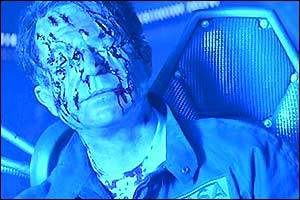
Let's consider Danny Boyle's Sunshine as both a characteristically exaggerated response to environmental crisis and an extended visual pun on the term 'Enlightenment.' The genre is easily the one most in tune with my lizard brain, sci-fi horror, combining an alien menace, cosmic scale, and the latent erotics of the military-industrial complex. The premise is suitably elegant: an elite crew of astronauts have to rejuvenate the dying sun by penetrating it with a huge bomb, thus saving the human race from extinction. There's a jingoism to this film that is no less present for its lack of national identification or corresponding ideological threat. It delivers the jingoism of crisis, its stance resolutely 'post-ideological,' a fantasy wherein the reactionary instincts of the nation-state are subordinated to the non-negotiable reality of impending destruction (though memorialized, aesthetically, by the pretty faces of the globalized cast). Humanity can then be reduced to its more cinema-friendly, individual-universal 'weaknesses,' such as lust for power, envy, moral feeling, and susceptibility to the sublime. All of which prove themselves to be liabilities in the crisis situation, if forgivable as sources of dramatic suspense, bathos, etc. A more 'objective,' classier...right, the UK, post-9/11 version of Armageddon.

So do we then say Sunshine belongs with the recent spate of non-U.S. westerns, the parent genre to a certain dominant mode of science fiction? Naught Thought thinks so, in this piece understanding the already post-national history of the European Enlightenment as one with the history of colonial expansion and imperial violence. The obvious touchstone in contemporary philosophy is with Jean-FrançoisLyotard's essay "Can Thought go on without a Body?" where the extinction of the human body is equated with the death of the sun, the absolute limit of thought. Bodiless thought is not without material conditions, but is also not reducible to preserved remains or combinatoric repetitions, the recorded memories which might manifest in, say, a satellite that outlasts the collapse of the solar system. Artificial intelligence, Lyotard claims, cannot be reducible to a program. It must be able to transgress its own limits, must carry some immanent differend, a complex, a libidinal motor for drives, desires, will. It must suffer. Thought, like the marauding cowboy, must have spurs.

Lyotard's philosophical myth can be read as a gnomic restatement of the question of 'late capitalism' -- how does expansion continue in a post-ontological (post-national) universe? More or less rhetorical, its function is to reinforce the truth of its presuppositions. Post-American westerns and western-infused sci-fi serve as good popular counterparts: anti-heroes slay evildoers in spectacular fashion despite existential ennui. But the intrusion of horror complicates things somewhat. The inversion of the western, horror consists of variations on home invasion rather than the quest. Its villains tend toward the abstract. Like obvious influences 2001, Solaris, and Alien, Sunshine's setting is a 'haunted house in space,' a seemingly familiar structure infected by its vast, unfamiliar outside.

Though the sun's five billion years premature decrepitude is never explained within the film, on the DVD commentary we're informed that an invisible force of matter gets trapped by the mass of the sun and begins to eat its way out. We're also told that because of our sun's relatively middling mass, this could never actually happen. Despite the realism of the hardware and the performances, then, the film is really closer to a thought experiment with set parameters, one of those 'push the fatty or pull the lever' things, than to traditional 'speculative fiction.' And unlike conventional horror there is little mystery even for the characters -- the premise is, not exactly established, but asserted beforehand: "If the sun dies, so do we." Lyotard's question is answered with a simple "no."

Aesthetically Sunshine is wonderful when the sun is front and center -- CGI actually works in space -- and enjoyable in that modern, overbearing way when its not. Though like many movies these days it demands you think it intelligent for quoting the 1970s, and in the end a third-act slide into Event Horizon territory ruins all hope for respectability. After a series of moral dilemmas where the crew makes increasingly irrational blunders deviating from 'the mission' (trying to save the crew of the previous vessel is the first fateful misstep), they find themselves stalked by a crazy speechifying Romantic villain, in the Kurtz/Pinhead vein:

I am Pinbacker, Commander of the Icarus One. We have abandoned our mission. Our star is dying. All our science. All our hopes, our... our dreams, are foolish! In the face of this, we are dust, nothing more. Unto this dust, we return. When he chooses for us to die, it is not our place to challenge God.


Pinbacker's God-given task is to 'enjoy,' once and for all, the limit that the crew is determined to transgress. This limit, the border between the human world tamed by Enlightenment reason and its conditional beyond, is transcendentalized, the products of the former -- organized life, technoscience, the 'modern world' -- understood as a gnostic veneer over the Truth. After all, death, the horizon of experience, makes life itself intrinsically unknowable regardless of what form it takes. "Resembles Life what once was held of Light, / Too ample in itself for human sight?" But the significance of the 'beyond's' effect on the 'here' is reversible: plenitude or negation of meaning. In Lyotard's understanding, if thought dies with the sun, then "everything is dead already." Pinbacker, on the other hand, aims to preserve the dialectic of human and inhuman knowledge by halting its progress, thus sacrificing the human species in exchange for an eternal moment of personal transcendence.

Pinbacker's wish for 'totalitarian' transcendence is countered by the moments of selfless, hopeful transcendence experienced by (some members of) the heroic crew. A moral lesson: being obliterated by the sun while saving people is just as awesome as being obliterated by the sun while exterminating them. Quite apart from the romance of Enlightenment, the film's obscure object of desire, is the persistence of a certain ethical code, staged here as logical responses to objective facts. If the crew had stuck to the mission parameters (if they hadn't been swayed by moral sentiment to try and save the previous crew) they would have all survived. We are reminded over and over again that 'transcendence,' a category which seems to encompass more and more each day, is theft, from man and reason. A delusion, a drug trip, a private spectacle. A luxury. The last shot is the homestead on Earth, saved by what they will never know. In a time of certain crisis, an elect is permitted to live like heroes so that we don't have to. For us the sensible thing is to follow orders. 'They' will never know, but we will, all for the price of a ticket. Certain crisis. Would extinction matter if there were no one there to enjoy it?

Thursday, May 29, 2008

monkeypocalypse

While we were sleeping writing our papers, monkeys executed the first stage of their three-pronged plan to take over the world: learn to control robotic arms with their thoughts.

I don't need to tell you about stage two.


Thanks to Alex Greenberg for the shout-out.

Friday, May 16, 2008

Polygraph 22: Call for Papers

Polygraph 22—Call for Papers
http://www.duke.edu/web/polygraph/cfp22.html

Special Issue: Ecology and Ideology

The contemporary moment abounds with speculation concerning our ecological future. Specialists in a variety of fields forecast immanent catastrophe, stemming from a combination of climate change, fossil-fuel depletion, and consumer waste. The recent bestowal of the Nobel Peace Prize on a group of scientists studying climate change indicates the degree to which "peace" has come to signify ecological balance; even the declaration by the Vatican of a new set of "7 Deadly Sins for the modern age" includes pollution in an attempt to grapple with the potential of individuals to inflict ecological damage on a global scale.

In the name of an impending crisis felt to be collectively shared, new political, cultural, and intellectual alignments are being forged, just as seismic shifts in the flow of global capital once again threaten to "redistribute" the world's resources and people. Ecological crisis has become a 24/7 media event, canvassing the planet in the imagery and rhetoric of disaster. From the halls of research and policy to activist documentary and apocalyptic fantasy, at the news desk, podium, pulpit, classroom, and computer monitor alike, all channels are united by a single underlying conviction: the present ecological catastrophe has humanity as its cause.

Precisely because the answer seems so obvious, we want to know: why now? Where are the points of antagonism in the midst of such apparent consensus, and what is at stake in their difference?

The Polygraph Editorial Collective invites papers concerning any aspect of ecology's relationship to ideology, both interrogating ecology as a location for critique of global capitalism and analyzing the ways in which ecology functions as an ideology in its own right.

Potential areas of interest include:

Political Ecology
Globalization and ecology
Marxism and ecology
"Environmental accounting" as a challenge to the free market
Ecology and capital / consumerism
Ecology as growth market

Eco-Disaster
Peak oil and climate change
Biofuels and the food crisis
Overpopulation and Neo-Malthusianism
Ecology as a rhetoric of control
Figurations of eco-disaster in popular culture

Religion and Ecology
Green apocalypticism and green evangelism
Ecology and world religion

Ecology and gender
Recent articulations of eco-feminism
Eco- & transnational feminisms
Women's work and the global chain of production
Agricultural work and reproduction

Ecologies against ecologies
"Light" vs. "dark green" environmentalism (i.e. deep ecology)
Primitivism and technofuturism
The status of international Green movements

Polygraph welcomes work from a variety of different disciplines, including critical geography, cultural anthropology, political economy, political theology, science studies, and systems theory. We also encourage the submission of a variety of formats and genres: i.e. field reports, surveys, interviews, photography, essays, etc.

SUBMISSION DEADLINE
December 31, 2008

ISSUE EDITORS
Gerry Canavan
Lisa Klarr
Ryan Vu

CONTACT
polygraph22cfp@gmail.com

Thursday, March 20, 2008

kidding on the square

Apologies for the slow posting—we culturemonkeys are just coming off our Spring Break. And preemptive apologies for the post that follows, as well, another public exercise in trying something on for size...

The chart at right is Jameson's Greimas square for Olaf Stapledon's Star Maker, not only one of the finest science fiction novels ever written but a kind of overarching theory of SF, a compendium of all that is possible along a certain trajectory of recombinative imagination. In the case of Star Maker, as the square suggests, that trajectory is the dialectic of the one and the many, the interplay that informs all of the planetary social systems that the novel's narrator visits. The other diagonal represents the theoretical countermovement in the novel, dualism and nondualism, those places where the opposition between the individual and the community is represented as nondialectical (and usually reformulated as good/evil, progress/anti-progress, life/death, futurity/apocalypse, and so on).

Mapping out the novel in this way we find its principal moments and various figurations nicely laid out.

While discussing Star Maker the Futurity group found ourselves playing with a Greimas square of our own, a collaborative square I put forth now not because I believe it is right and complete but because I want to discuss the ways in which it might be wrong.

I've modified the square slightly since we talked about it, which is something we can talk about in the comments.

The square is an attempt to lay out the component subgenres of speculative fiction along these semiotic lines.

We take as our first opposition the difference between science fiction and fantasy/eros, following Jameson's borrowing of Coleridge's distinction between imagination and fancy but aligning "imagination" as much with "the erotic" as with fantasy. Science fiction's theoretical extreme would in this sense be more a novel that is more Star Maker-esque than even Star Maker itself: this is the programmatic business of speculative engineering and genre combinatorics. This is nerdonomics, operating on a scientific-mathematic logic. The erotic, on the other hand, is pure arousal—affect. The relevant aesthetic example here is not the pornographic so much as poetry and myth: the idea of Camelot, outside any consideration of how many people should live inside or how tall the walls the should be. This is the dream logic of pure imaginative play.

On the other axis, we map horror against spectacle, spectacle in the Debordian sense of a manifestation of pure positivity:

The spectacle manifests itself as an enormous positivity, out of reach and beyond dispute. All it says is: “Everything that appears is good; whatever is good will appear.” The attitude that it demands in principle is the same passive acceptance that it has already secured by means of its seeming incontrovertibility, and indeed by its monopolization of the realm of appearances. (The Society of the Spectacle 15)
Horror, then, is anti-spectacle—it promises us violence, real, raw, and uncontrolled. But as with science fiction and the erotic I mean to keep these two terms free from other valences or connotations outside the foundational distinction between positivity and negativity, for as we all know there can be an Dionysian ecstasy to violence just as surely as there can surely be a terrible unfreedom in spectacle. What I'm interested in right now is just the question of imaginative method, trying to identify the sorts of moves that can be made through speculative fiction.

When science fiction combines with horror, we get Frankenstein and its many children; when it combines with spectacle, we get Star Wars. Likewise, when Eros and fantasy combine, we have the seductive myth of the vampire; when it's spectacle and fantasy, we have the pornographic, or, more accurately, the polymorphous perverse.

Borrowing from the apocalyptic suprahistorical cycle of Star Maker, our group then flirted with an ambitious addition to the chart: an attempt to overlap a mapping of the Utopic and the apocalyptic in relation to these terms. We struck upon the notion that perhaps Utopia can be seen as the standpoint of eternity, the position which all the deviations and excesses of the four subgenres—each one trending in its own way towards the boundary condition of apocalypse—are read against...

Saturday, February 16, 2008

Digression: There Will Be Blood

Finally got around to writing about this, this messy, occasionally brilliant, reckless like it doesn't matter anymore (it doesn't) mythography of capital. I mean this quite literally. Most discussion of this film assumes that it is about a fictional oil baron named Daniel Plainview, loosely based on the life of Edward Doheny and overplayed (either self-consciously and well or sloppily and poorly) by Daniel Day-Lewis. This is not accurate in any meaningful sense. Plainview is not really a character, not a psychological or biographical portrait of a human being, but a mask. There is more than a void behind it (no existentialism here) but far less than a man. 'He' is simply capital embodied in the shape of a familiar archetype, the criminally ambitious Citizen Kane-style tycoon, perhaps more familiar to us as one of Coppola's or Scorsese's gangsters, Hollywood's favorite way (because it still involves a masculine hero) to critique the American Dream. Also misleading is that the film looks and is structured a lot like those '70s-era epics that have become our new classical canon. But while we may get their de rigueur rags-to-riches-to-hubristic-decline narrative arc, Plainview undergoes no fall from innocence. He does not change or develop, except maybe to get a little meaner, a little more desperate, as the film drags on and his cover wears thin. His reaction to developments in the plot have the form of epiphany but not the content. The only glimpse we ever get beneath his skin is when he's covered in oil.


And yet the camera never leaves him. For a film with such epic ambitions, it has a remarkably narrow focus, rarely leaving Plainview's face even when others are conversing in his presence. This is not so we can witness the reveal, Method-actor style, of an entire history bound up in a momentary grimace or facial tic, it is for us to stare long enough at a human-like visage that we are no longer fooled by the illusion it presents. One might expect his relationship with his adopted son is meant to 'humanize' him, but it does no more than prove the opposite. He relates to his child like an alien he was only briefly instructed how to interact with, when not simply using the boy as a tool to convince investors he runs a "family business." While the emotions and interests of others can be temporarily forced into him -- witness the forced baptism scene where Plainview is made to suffer something that appears to be guilt by the craven preacher Eli -- he can only relate to those who share his blood. By the end it is clear that no such person exists in the film.

Nevertheless, we are constantly teased with the notion that Plainview has a past. And maybe -- maybe the archetype does, some string of banalities that would explain nothing. But every possible example we see turns out to have been a lie, and he is driven to murder any relationship that might accumulate the necessary substance to become part of a meaningful biography. Anyway we are watching him for other reasons, for the myth-history of capitalism, the occult specter whose logic 'speaks' his every action, subverts or destroys his every companion, dominates his environment by draining it dry (Anderson claims he was thinking of Dracula when writing the screenplay), destroys a community by turning it into a city, and eventually leaves his body a withered husk, to flake and die like a leaf in wintertime. "I don't like to explain myself." The film's trappings often resemble the Gothic, the genre of secret histories, but it's all appearance; there is nothing to explain.

As many others have said, There Will Be Blood belongs above all to horror.

This is what truly makes it comparable to No Country For Old Men, more so than a certain nostalgic '70s-era aesthetic and level of ambition. It's the fact that the monster at the heart of both is supernatural, though not in the usual sense. Chigurh too is just a generic mask, the relentless , invincible psychopath stalking countless horror thrillers, this iteration something like a south-of-the-border cross between Hannibal Lecter and Michael Myers. But he hides a secret ethical and perhaps metaphysical function, the entire narrative of the film structured around working out its derivation, victim by victim. Its rule, however, Chigurh's 'motive,' is impervious to unveiling by any mere story, which reduces us, literally, to guessing at the outcome of a coin toss.


Though their secrets are different, the real horror is that there are no secrets on the cause and effect level of narrative, that it is mystery and not truth which is constructed through the films' artfully cut withholdings of information; that the 'brute facts' and the logic connecting those facts is artificially, even demiurgically, rendered unclear -- mystified. It's a function traditionally reserved for female characters, but unless they are the victim/protagonist there is no place for them in horror. Chigurh and Plainview, the hollow monsters, as both engine and devourer of narrative, instead take its 'structural' lacuna inside themselves, and in so doing irresistibly draw the camera's gaze. Here the affect of horror, created subtly with lighting, soundtrack, the whole range of traditional cinematic technique (there are no Special Effects allowed) is all that is capable of concealing the underlying absence of mystery with something else. What? Diegetically nothing happens which could not conceivably be explained, and yet somehow we emerge certain that a really adequate explanation is impossible. An invisible force (TWBB) or axiom (NCFOM) is evoked, secretly guiding events. That its repression is also made palpable to us, that it isn't merely a function of plot (Plainview and Chigurh's 'sins' 'acknowledged,' through redemption or punishment) but tied instead to the conventions of 1970s Hollywood realism, is at once the artistic achievement of the two films and, I suspect, their ideological core.


In TWBB one gets the impression from Eli, a grotesque parody of Christianity as both the paradigmatic model for non-capitalist politics and a type of show business, that stories can no longer be seriously invested in. Instead we learn to see Plainview the same way he sees others: "I see the worst in people. I don't have to look past seeing them to get all I need." In the much-criticized final showdown in the bowling alley, this impression of God and his earthly salesmen is rendered painfully concrete. It's the scene where the film's facade of realism, though always unsettled, is strained to the point of absurdity: the priest recants, he is made to suffer for his sins, and behold, his milkshake, it hath been drunk! But not even the grand narrative of entrepreneurial capitalism can survive past the last shot. The realization that has been building over the course of the film, in the form of Plainview's increasingly strained encounters with Standard Oil and the unstoppable expansion of monopoly power it represents -- that the individual capitalist is no longer a suitable vessel for the daemon of capital -- comes at last to fruition, and so with the resignation "I'm finished," the lights go out. The camera apparently hasn't the right to follow. But is it irrational hope to wonder if nostalgia for the end of a distant era can reflect any light back on the end of one still present? Or has Plainview eaten that as well?

Friday, February 8, 2008

survivability and thinkability

I'm trying something on for size here. I'm not sure I'm ready to make a down payment.

"...the trauma suffered by everyone in the middle of the 20th century when it became clear that from now on to the end of human history, every person would spend his individual life under the threat not only of individual death, which is certain, but of something almost insupportable psychologically — collective incineration and extinction which could come at any time, virtually without warning."
—Susan Sontag, "The Imagination of Disaster"

"Perhaps if we have a terrible privilege it is merely that we are alive and are going to die, all at once or one at a time."
— Frank Kermode,
The Sense of an Ending

"What protects us is that in nuclear war the event is likely to eliminate the possibility of the spectacle.
This is why it will not take place. For humanity can accept physical annihilation, but cannot agree to sacrifice the spectacle (unless it can find a spectator in another world)."
—Jean Baudrillard, "Fatal Strategies"


In Vonnegut's Cat's Cradle, Bokonoists announce "Now I will destroy the whole world" when they elect to kill themselves. Individual death bound up with collective death, even universal death—this is the ethical question smoldering at the heart of futurity. Why should I care about anything that happens after I am dead? Or, from another angle: why should the potential annihilation of society fill us with so much more revulsion and dread than the certain prospect of our own inevitable demise?

Or: What does it mean to imagine a future, good or bad, Utopian or dystopian, without you in it?

There is surely a biological imperative at work here—but there is also, it seems to me, a phenomenological one, a kind of onto-epistemological blind spot that demands the projected permanence of one's conscious mind, the makes the actual absence of one's personal subjectivity by definition strictly unimaginable, strictly unthinkable.

Thus, we rechannel our own self-consciously impossible wish for immortality into an imagined collectivity that extends into the future, and the death of collectivity thereby becomes renewed as both the object of horror and the object of desire—in both senses really just our own denied deaths returned to us.

Futurity is the (failed) denial of death.

We can find this impossibility of representation revealed in any imagination of apocalypse—the promise of survivability (and therefore futurity) emerges in any ultimate disaster, the point of view character who dodges every bullet and emerges through to the other side, whether to rebuild capitalism anew or simply wallow decadently amidst the ruins. Even the rapturous, totalizing moment of nuclear annihilation has its inevitable excess, tunnels hidden underground where life, it is imagined, might still go on.

And even in the very rare case where narrative does let the bomb does go off, where all life ends, still we watch it happen from a cosmic position of complete safety, an atemporal position of non-embodiment—outside the text. Think of your position when you see the Earth blow up. Where are you standing?

On the Beach, which with its slow and horrid countdown to the total extinction of humanity heroically attempts to face this problem of death head on (and which consequently may well be the most depressing book ever written) in the end cannot dance to its own music: after jumping perspectives over and over in its final chapter, hoping to escape the necessary moment, it ends with its American hero and his doomed crew still technically alive, still sailing south, towards what little is left.

Bazin writes in "Death Every Afternoon" that “for every creature, death is the unique moment par excellence.” Whether it is personal extinction, or atomic Rapture, or H.G. Wells's giant crabs scuttling about on an empty Earth, death is futurity par excellence; it is that moment towards which all things point but which no things point beyond. It is the most unknowable moment of any history and yet the most familiar—we are doomed to speculate over and over “What if I were dead right now? What if I am to die in this next moment?”, but despite its intense familiarity we are completely unable to ever consider the absence of our own consciousness. Always, this is the way we imagine death: a still body inhabited by a still-waking mind, observing ghosts hiding haunting the ruins. Any and all narrative representations of death must necessarily fail—all possibility of identification ends at the moment when the represented figure dies, at the necessarily distanciating moment when we recognize the character has died but we are still alive. (We can recognize death, but never our own.) Consciousness cannot negate itself; it is always there, even when it is trying to play dead.

We are dealing here with something narrative promises but can never deliver: the authentic, projected sensation of surviving ourselves, in the sense of outliving either our physical bodies or the techno-social, biopolitical structures with which life has become functionally identical. Narrative—and not merely in the death scene or in the apocalyptic sci-fi thriller, but also in the jump-cut, in the chapter break, in the fade-to-black and the page turn after The End—can only reinforce the quintessential solipsism endemic to symbolic consciousness: the principle that no matter what happens our subjectivity is eternal and inviolable, that each of us occupies the center of the universe.

This ideological reinforcement may be called, after Bloch, the dystopian function, and while we can find it across genres we can find it most clearly in horror, in apocalyptic fantasy, in science-fiction disaster, in rape, torture, szchiophrenia, madness, snuff, Holocaust, nuclear winter, death: in depicting what's as-bad-as-things-can-get, we are at the same moment promised that we can survive radical transgression, that nothing can undo us, that our individual subjectivity will survive all, even total destruction, even its own destruction. The dystopian function provides the vicarious, spectacular experience of how bad things might get precisely so that it might again make the impossible promise that you will somehow pass through safe and whole to the other side.

So perhaps we could just as well call it the denial-of-reality principle.

Narrativized attempts to transgress the radical boundaries of bodily integrity and societal longevity, to take the reader over the line into new territory, are always a stretching, never a transposition—the subject will always return to where she is anchored in the end, she will neither move nor break in two. There are limits past which neither representation nor imagination can take us, though we may compel both to try. The dystopian function will always in the end fail the reality test: you cannot just sample death, you can only plunge fully into it. Like any other subgenre of futurity, apocalyptic fantasy—relying as it does on the continuity of subjectivity for its very transmission and comprehension—can never shake us from our subjectivity, and so despite its obsessive attempts to transgress of the life/death, now/then boundary, it is always doomed to fail.

Monday, January 21, 2008

the past as anti-future

Our in-person discussion last week ended up on some interesting ground that bears heavily on the question of the end of the world as a cultural form. We found ourselves wrestling with the question of the origins of apocalyptic fantasy, why these sorts of productions are so very popular. We basically hit upon five overlapping and sometimes contradictory motivations:

1) The roller-coaster hypothesis: We are able to enjoy scenarios about radical destruction or the collapse of civilized society because we do not fear they will ever come to pass.

2) The survivalist hypothesis: We consume these scenarios precisely because we believe they will come to pass, because we know they must come to pass.

3) The recursive hypothesis: Apocalpytic fantasies succeed in the box office and the best-seller lists because these sorts of fantasies had succeeded in the past. In other words, consumer culture just keeps feeding us the forms that have already worked, over and over again.

I think this is probably at once the best and worst answer, as it explains Cloverfield better than anything else, but can't explain the genesis of our initial attraction to the form at all. Take this as a given—I won't be talking much about it.

4) The bare-life hypothesis: We enjoy apocalyptic fantasy because we have been primed by ideology to recognize the absence of civilization as a ultra-Hobbesian state of permaviolence and degradation, which is to say that the purpose of apocalpytic fantasy is to serve as reinforcement and justification for the biopolitical power structures that already exist.

5) The wish-fulfillment hypothesis: We persist in imagining the end of the world because we secretly (or not so secretly) long for the destruction of society in general and/or capitalism in particular.


I'm tempted to note here that #1 generally goes with #4, and #2 generally with #5—but I don't believe it's that simple. They're all inextricably bound up with one another. I'm happy to accept "overdetermination" as the answer to this argument, but not without qualification—I think we must acknowledge that Jameson is essentially right when he insists (following Bloch) on the Utopian kernel at the core of both cultural production and daily life. Without #5—without the carrot, whatever form it takes—apocalypse could never sell. There are plenty of places where Jameson says this, but I thought it might be useful (given that our discussion last week came to focus on what exactly is the Utopian hook in a movie like Saw IV) to look at Christopher Sharrett's well-known essay on The Texas Chainsaw Massacre. Not all of it is available online, but a good portion of it is through Google Books, in particular the part I was hoping to quote:

The point to be made here is that the failure of America's sense of divinely ordained "mission," the development of pessimism and the fixation by many American artists on a nonregenerative apocalypse, suggests a kind of wish-fulfillment calling for an end to history, a divine intervention meant to destroy what cannot be revitalized or what has worked against the earlier collective (that is to say white, male, capitalist) beliefs of society.
What is the nature of this wish-fulfillment? Against Sharrett I would suggest that it is almost no different than the catastrophe of science fiction, or rather that it is of a piece with the tripartite possibility that is opened up by the end of the world. When we pass through societal collapse and find ourselves on the other side, three dialectically interrelated possibilities present themselves:

1) We are now free to rebuild capitalist society, but "right" this time. This sort of story inevitably involves a kind of jack-of-all-trades, Swiss-Family-Robinson, white, male, capitalist Übermensch with exactly the skillset necessary to rise to the equation and restart civilization.

We can see already that this narrative hits nearly all the points above—the latest in a long tradition of Robinson Crusoe stories (#3) that we simultaneously don't fear and yet always expect (#1 and #2), this type of post-apocalyptic fantasy both wipes clean the slate of capitalism's practical injustices (#5) while simultaneously justifying an idealized form of capitalism as the natural state of humankind and our only protection against a life of utter deprivation (#4).

You can usually tell you're in this kind of story when the story ends just as it looks like they're about to get the lights back on.

2) In a second variation on apocalpyse, we find ourselves in the state of nature, again as an Übermensch but this time as one finally empowered to fight and struggle and conquer completely freed from societal constraint. The collapse of society is equated with the collapse of all taboo, allowing us to "do whatever it takes to survive," which often just means murdering other people without compulsion, but sometimes also includes such psychoanalytic breaches as abandoning our wives to sleep with our daughters. The post-apocalyptic here is therefore bound up hopelessly with both nightmare (#4) and with wish-fulfillment (#5)—the one feeds into the other—but it is a nightmare that our identification with the hero allows us not only to survive, but on some level enjoy. (This, as I argued in our meeting last week, is the brilliance of High Rise—Ballard makes all his characters so unlikable that we are denied identification and left with just the nightmare.) Clearly, too, this is a thrill ride (#1) that positions us through the power of identification as the unbound survivor hero we all imagine we would be (#2)—we are able to experience at last (albeit vicariously) the total freedom we long for (#5 again).

3) But there is a third track, which might be called the "quiet end" for capitalism, and which in a kind of reverse synthesis leaves #1 and especially #4 out of the equation. While there is always deprivation and destruction, it is always downplayed in favor of a survivalist mentality that denies the capacities of the individual survival in favor of the collectivity of survivors. It is here, not surprising, that we find the Utopian kernel in its purest form, and likewise that we find renewed in these stories a new sense of history that extends far beyond the "Great Disaster" and its immediate aftermath. This is the longed-for apocalypticism of primitivism or of Earth Abides, a life free from capitalism's pressures and contradictions, a literal turning back of the clock. The past, then, not merely as anti-future, but as super-future.

In the most extreme of these fantasies, as in 2007's The World Without Us, there are no longer any people at all—a strange Utopia, yes, but an undeniable one.

The sheer incomprehensible violence required to ever get there from here—the massive, world-historical hardship that would have to be endured—makes these vision of an ahistorical future no less Edenic when they are presented to us, especially—and this may well be the key point—given the fact that the power of narrative identification always ensures our personal passage, no matter how improbable, through the crucible of Tribulation into a better world.

Monday, January 7, 2008

Week 0: Space, More's Utopia, and Time

Recent blogospheric polemicists have argued against a politics predicated on Utopia on the grounds (if I may summarize) that it is Utopia's very impossibility that is actually its most salient and essential characteristic:

Utopia: perfect, not meant to be found, impossible, hidden, veiled. It is perfect because it is the place where veils are unnecessary. No place for deception when everything is truth. And this is why it must always be displaced — the term ‘non-place’ suggests the absence of something that is always and essentially present to the speaker, the very conditions of speaking. Utopia as double negation, the (necessary) absence of an (impossible) absence.
I think this is largely right, but it elides somewhat the reason why: what has happened to Utopia since More published is that Utopia has shifted from a spatial concern—an actual place impossible to reach—to a temporal one—a possible future you won't live to see.

It's not simply that More, playfully insisting in the prefatory material it's all really true, locates his Utopia in the New World, a distant location well outside the horizon of experience for nearly everyone alive in his time; nor that someone coughs at the moment Raphael Hythloday reveals the island's exact location (as recounted in Busleyden's letter); nor that the sea is so unnavigable and dangerous around the island that "it seldom chances that any stranger, unless he be guided by a Utopian, can come into this haven" (first page of book 2). It is the inescapable nature of a spatial Utopia like More's, an Atlantis or a Shangri-La, to be actual and yet essentially unreachable—really, to be a kind of a parallel universe in an age when there was still room enough for them to exist on Earth itself.

Following More, however, Utopia has been relocated from a location in space to a moment in time—the future—and accordingly we have exchanged Utopia as a signifying noun for the Utopian, a metaphorizing adjective. Now Utopia is no longer actual—it doesn't yet exist—but it is reachable, at least in some theoretical sense;it is realizable through the actions of those individuals for whom it is still yet a dream. This potential reachability draws its logic not from the travelogue, as did More's Utopia, but instead from the religious promise of Christian eschatology of the Kingdom of Heaven (usually the substitution is as easy as replacing the Christian savior for a new one).

At the risk of splitting my hairs too finely, I'm speaking here of the difference between the alternative and the potential.

The move from a perfect place to a perfect time necessarily interjects the impossible questions of planning and transition that are objected to in the linked post. To get from England to Utopia (or from Earth-1 to Earth-2), you only have to know in which direction to sail; but to get from the present to ecotopia or the Singularity you have to plan—you have to build. Any Utopian project becomes quickly and hopelessly overrun with logistical impossibility, and accordingly the relevant imagined timeline becomes more and more prolonged:it's not going to be easy; it's a long hard slog; it's the struggle of a generation; it's a generational struggle; I may not get there with you, but I believe...


This is where the longing for apocalypse originates, in the desire for a radical break that does all the work for us at once.

But there's a dialectical countermovement to this longing for apocalypse. As change and progress become so slow as to resemble stasis, the long arm of the future and the impossibility of ever reaching it has a second and even more pernicious effect on the imagination of Utopia: in addition to voiding the Utopian of its political power and reducing it instead to the failed dreams of the naive for a "perfect world," it also respatializes Utopia, reinscribing it back inside the present. Our teleological view of history makes this happen. If the Utopian dream of tomorrow can be built out of the present moment, the future and the present begin to telescope, narratively, into a single, indistinguishable motion. If the warm-up pitch begets the pitch begets the swing begets the hit begets the arc of the ball over the infield begets the home run that is the end of history, then in a narrative sense they're all Utopia. To be anywhere along the path to Utopia is to already be as close to paradise on Earth as one could possibly be. Insofar as Utopia is impossible, the present is all we have, and insofar as it is inevitable, the present is still all we have. This is how Utopia becomes respatialized not as parallel world or impossible alternative but the nation as it currently exists—no longer over there but here, now, with ever-more empty and vague gestures towards progress or a better tomorrow. This, I think, is the genesis of American exceptionalism: the temporal potentiality of the city on the hill becomes confused with the nation's spatial actuality, and suddenly the possibility that we might be moving towards Utopia becomes proof we already live in it.

Sunday, October 21, 2007

early thoughts towards a dissertation of some type

According to USDA statistics, only approximately 2 million Americans are still directly involved in agricultural production, and of those people only 10% of the average farm family’s income comes directly from farming. As the link notes, there are as many architects and engineers as farmers, and nearly twice as many people play World of Warcraft online as farm for a living; there are four times as many people living in New York City alone. As the urban population grows and the rural population shrinks, with more and more people managing wider stretches of increasingly disappearing farmland, capitalism develops a new flashpoint for crisis. Technological advances have allowed for a relatively small number of people to feed hundreds of millions, but these same innovations place increased pressure on what few food-producing areas remain. Rather than merely threatening local populations, the deterritorialization of agriculture means that cyclical variations in weather patterns can now threaten the entire (inter)national population, and disease and insect infestation can wreck far more havoc than ever before. There is a typically Marxist paradox here: technological advances in the last two hundred years have made food production easier and more reliable, which has in turn allowed the population to expand to the very limits of sustainability—such that relatively small disruptions in the food supply can now threaten severe hardship, especially in the Global South.

This same flashpoint, once identified, can be found across late capitalism. Consider for instance the current severe drought in the American southeast, a situation exacerbated by irrational patterns of development and population distribution that did not take into account infrastructure demands; the engineering marvels our advanced technology allows us to accomplish carry with them an increased interconnectivity and interdependency (and thus vulnerability and proclivity to crisis). The mechanized production we depend on requires such massive daily replenishment that temporary local slowdowns are felt across the system; a single hurricane in New Orleans causes gasoline prices to shoot up nationwide (never to come back down) and the failure of a single power station in Ohio causes a blackout across the entire Northeast.

Indeed, advanced social productivity as a whole would seem to hang upon a single loose nail, global oil production, which according to the most recent figures seems likely to have peaked in late 2006. As of yet there is no cheap energy alternative to oil, and the powers-that-be do not seem especially concerned about finding one (we are assured instead that something will be invented at the last minute to save us all). These phantasmagoric technologies of free energy and total automation, always just around the corner, would seem to be based in science-fiction stories of the late 19th and early 20th centuries and bear little relation to science as we know it today. If anything, we seem actually to be rapidly approaching the absolute physical limits of battery storage and processing power, barriers past which we are unlikely to be able to progress.

Meanwhile, the oil age has grown the population from one billion people in 1800 to seven billion people today, and they will all require food, clothing, and shelter. Without some alternative to oil to drive the mechanized agriculture we now depend on for survival there will be unprecedented, almost unimaginable material suffering across the globe.

It would seem to me, then, that there is ample room now for a reconsideration of Marxism along environmental lines and the creation of a new teleological trajectory for capitalism, one which does not reach its liberatory apotheosis in the separation of production from exploitation but instead self-immolates in the apocalyptic extinguishment of production altogether. Moreso than revolution, the dystopia of de-development we now face strikes me as the real logical consequence of the capitalism, which can never plan ahead, and which can never say “enough.”