Showing posts with label science fiction. Show all posts

Wednesday, July 23, 2008

Apes, legal personhood and the plight of Nim Chimpsky

Apes, legal personhood and the plight of Nim Chimpsky.

Eberhart Theuer: A legal person would be something like a company or a certain society that in itself, or a fund that has certain rights without being a natural person.

Anita Barraud: This is similar to the US in common law notion of a juristic person that can apply to corporations and organisations that they're artificial persons created by the law.

Eberhart Theuer: Exactly.

Paula Stibbe: It's not talking about the rights for non-human animals to go and vote or be able to go to university, that would clearly be inappropriate and ridiculous. This is about recognising that non-human animals share with us sentience, which means that they have the ability to suffer, and that they have interests which can be damaged.
In sci-fi-philosophic terms, this is the distinction between sapience and sentience; while apes likely cannot "think" in the human sense, they and other animals can certainly feel pain, and that capacity is something we are morally obliged to respect.

I say likely because I am by nature extremely wary of the anthropomorphistic tendency to project human emotions and consciousness into animal behavior that is actually instinctual or learned—in general I'm impressed with Daniel Dennett's theory in Kinds of Minds that our dogs appear to "love" us precisely because we've selected for just that impression over millenia of canine domestication. But as an anecdotal matter I must admit this is really evocative:
Paula Stibbe: I've learned what he likes to do most, what food he likes to eat most, though that would include some games. He likes to use charcoal with paper sometimes to draw, or chalk.

Anita Barraud: What does he draw?

Paula Stibbe: They are kind of abstract angular kind of works and he takes the paper and the chalk and he leans against the wall, he bites his bottom lip and concentrates really hard on what he's doing. He won't let himself be distracted while he's drawing.
(cross-posted at gerrycanavan.blogspot.com)

Tuesday, July 22, 2008

thoughts on zizecology - 2

There are two primary axes of political conflict in Kim Stanley Robinson's incomparable Mars trilogy: first, the expected (almost generically required) question of independence vs. interdependence with regard to the mother planet, Earth, which is really a question about Utopia and enclavism that is concretized in the fierce battles over the space elevator; and second and more relevant for my purposes today is the fierce break between the Red Martians and the Green Martians. The Greens believe the planet should be terraformed so as to inhabitable by humans without mechanical assistance, a technical problem that clumps around issues of surface temperature, atmospheric composition and density, and unpredictable climactic feedback mechanisms; the Reds believe the planet should be left as pristine as possible, whether because this is the only way it can be properly studied or because the otherwise dead rock is seen by some Reds to have a kind of mystical vitality all its own.


Of course, Greenism and Redism both describe ideological spectra, not discrete sets of propositions: some moderate Greens propose to terraform only up to a level of 5 km, leaving Mars's huge mountains relatively untouched, while others believe the planet should be maximally terraformed and still others believe it should be terraformed only to the light-facemask level—while for their part the Reds are divided between those who would only act as a partial brake on unchecked development and radical terrorists who bomb critical life-support equipment in an effort to force humans off the planet.

And Redism is surely doomed, doomed from the moment of its first articulation on the Ares bringing the First Hundred colonists to the Mars—doomed by the decision to colonize the planet in the first place, if not by earlier manned missions, if not by bacteria carried over on the Viking landers. The originary, humanless Mars—the natural Mars—is in this sense a logical impossibility—in order to exist at all, in order to be a real place as opposed to some far-off speck of light in the sky, Mars must exist for us, which is to say Mars must enter into (human) history. It must be changed; it must be ruined.

The Reds have always, necessarily, lost, though their recognition of this fact that doesn't dim their fervor.

I bring this up as in attempt to return to Žižek's critique of ecology, specifically the radical reconsideration of finitude he ignites in the latter half of the essay. Žižek seeks to unmask liberal ecology as simply the latest ideological backing for the biopolitical structures of capitalism as a whole. “Today’s predominant mode of politics is post-political bio-politics,” Žižek writes, and accordingly ecology’s primary locus of action should be understood as an ecology of fear. Žižek does not deny the reality of the potential catastrophe we face but rather opposes the ends to which this potential disaster is rhetorically purposed:

The lesson this ecology is constantly hammering is our finitude… This is why, although ecologists are all the time demanding that we change radically our way of life, underlying this demand is its opposite, a deep distrust of change, of development, of progress: every radical change can have the unintended consequence of triggering a catastrophe.
What Žižek reveals, then, at the heart of liberal ecology is a deep-seated, unacknowledged conservatism that weakly opposes the status quo in appearance only to work to preserve it in reality.

The ecology of fear’s recognition of our precariousness, of our absolute contingency, Žižek says, in fact induces us to cling to the devil we know:
With regard to this inherent instability of nature, the most consequent was the proposal of a German ecological scientist back in 1970s: Since nature is changing constantly and the conditions on Earth will render the survival of humanity impossible in a couple of centuries, the collective goal of humanity should be not to adapt itself to nature, but to intervene into the Earth’s ecology even more forcefully with the aim to freeze the Earth’s change, so that its ecology will remain basically the same, thus enabling humanity’s survival. This extreme proposal renders visible the truth of ecology.
And the problem goes still deeper. Given the Malthusian proportions of the current population of the Earth and the extreme, highly energy-dependent requirements for industrial agriculture alone, if the industrial civilization that is currently wrecking the planet were to suddenly stop, this too would be a disaster out of proportion with any ever experienced in human memory. We find ourselves trapped no matter which way we turn. “Nature,” as such, has in this sense already been entirely lost—an observation Žižek draws in part from Timothy Morton, author of Ecology without Nature, who writes that “it is very hard to get used to the idea that the catastrophe, far from being imminent, has already taken place.”

I am reminded here of Norbert Weiner’s memorable depiction of the human race as “shipwrecked passengers on a doomed planet” in 1950’s The Human Use of Human Beings. In recognition of the essentially entropic nature of the universe, Weiner asserts, the proper response is not despair or catastrophic fatalism but rather resolve to meet our challenges head-on and keep the final catastrophe as far off as we may. Weiner, despite his scientistic and technocratic positivism, becomes revealed as a proto-ecologist in this Žižekian sense, an ecologist aiming not at preservation but at utilization and manipulation.

Felix Guattari, too, comes to make essentially the same claim in his “The Three Ecologies”:
There is a principle specific to environmental ecology: it states that anything is possible—the worst disasters or the most flexible evolutions. Natural equilibriums will be increasingly reliant upon human intervention, and a time will come when vast programmes will need to be set up in order to regulate the relationship between oxygen, ozone, and carbon dioxide in the Earth’s atmosphere.
We can add to this a whole host of possible geoengineering projects, including the new proposal to add lime to the oceans to combat climate change that I blogged about just this morning. Guattari’s vision of a “machinic ecology” is positively Weinerian in scope, if not utterly Promethean—he goes on to argue that the telos of humankind is in part “to dare to confront the vertiginous Cosmos so as to make it inhabitable,” not simply to keep equilibrium or stasis but indeed to bend all of nature to our will (if with the proper ecosophic respect for life at all levels).

If all this is true, why then does contemporary liberal ecology present itself in opposition to technological civilization and progress as such? How does ecology resist the recognition of its own central contradiction? Žižek attributes ecology’s conservative blindness to a kind of childish denial, a refusal to accept emotionally what one knows to be the case intellectually, a psychological inability endemic to the modern age to reconcile cold scientific appraisal with common sense. Žižek—perhaps not unexpectedly—relates this fundamental divide between scientific knowledge and the Wisdom (“the basic trust in the background coordinates of our world”) we need to “unlearn” to Lacan’s notion of the “big Other,” the Symbolic figure whom we believe will “guarantee the harmony between the levels, to guarantee that the overall interactions will be satisfactory.” There is, of course, no big Other—we are flying blind, with no co-pilot—and the first solution to our predicament is the old Lacanian one of recognizing this uncomfortable fact: “And the lesson of ecology is that we should go to the end here and accept the non-existence of the ultimate big Other, nature itself with its pattern of regular rhythms, the ultimate reference of order and stability.”

What Žižek rejects here is any notion of equilibrium (to use the Club of Rome’s preferred term) or sustainability (to use the one currently in vogue). But this, it would seem to me, is in the end a too-wide application of the category of denial that itself amounts to an act of denial in the end. In the end, the fact must be admitted: All this—technological civilization, even one that is ecological in the Žižekian/Guattarian sense—simply cannot go on forever. There is, in the end, a limit point, some point past which it is simply impossible either to grow and expand on the one hand or perfect and regulate on the other. The laws of physics—the laws of Weiner’s entropic universe—are in the end a kind of actually existing big Other, a big Other of a sort that cannot be dispelled through Promethean know-how, or through the infinite adaptability of the market, or through a position of Lacanian self-knowledge. In the end, they are final, including and especially the first and second laws of thermodynamics (You can’t get something for nothing, and Things fall apart.) There is, in the end, reality, such as it is.

Given this, it seems prudent to inculcate some capacity to recognize and respect the limits to growth. In this sense Guattari and especially Žižek seem to get their infinities tangled up—the flexible recombination of the market is of a very particular and limited kind, and should not be confused with the actual ability to do anything. Žižek is wrong, too, to argue that finitude necessarily leads to a hopeless conservatism, because the recognition of our finitude is also the prerequisite for effective ecological knowledge and environmental policy in the first place. There could be no ecology without finitude—what need would there be for it?—and in this sense finitude cannot ever be tossed out; it must rather be acknowledged, and assented to, even as we seek to do what we can for ourselves within that frame. It is only in first studying and understanding nature as “the ultimate reference of order and stability” that ecologists can come to know what they can and cannot do, what is and is not possible—and therefore it is only in first recognizing and respecting natural patterns and regular rhythms that the ecologist can begin to do anything at all.

Finitude, this is to say, is better understood as an immanent principle of existence rather than as some transcendent imposition from above. The finitude imposed by entropic nature is as much the playing field as it is a barrier or limit point.

There is, of course, every reason to think that capitalism is uniquely unprepared to recognize either version of finitude, or to approach its production capacity with anything resembling rational growth—if, that is, we have not in fact already and unknowingly flown past it. Rather, as Foster continually reminds us through his invocations of Marx, capitalism itself is the primary accelerant towards our own immolation. The problem is not merely the ceaseless, unchecked drive towards accumulation—though this of course is crucial—but also the ways in which there is no ability under capitalism to regulate the desires of consumers except by sudden (and in this case likely irreversible) scarcity: a crisis. John Bellamy Foster writes in Ecology Against Capital:
For Marx, the very nature of capitalist society from the very beginning had been built on a metabolic rift between city and country, human beings and the earth—a rift that has now been heightened beyond anything he could have imagined…. There is an irreversible environmental crisis within global capitalist society. But setting aside capitalism, a sustainable relation to the earth is not beyond reach. To get there, we have to change our social relations.
Evoking John Kenneth Galbraith’s famous dependence effect, which reverses the classic economic relationship between commodity and need to understand capitalism as first producing needs for consumers which its products then step in to fulfill, Foster concludes that the relations of production within capitalism will simply never be capable of generating “a society governed not by the search for profit but by people’s genuine needs, and the requirements of socio-ecological sustainability.” In line with his understanding of Marx as a proto-ecological thinker, as elaborated at length in his 2000 book Marx’s Ecology, Foster calls this state of affairs socialism.

First and foremost among the things such a socialism will require, in part, is a ideology—really, an ethos—that would allow us to imagine a future for humanity that is neither radically Utopian or radically dystopian/apocalyptic, but rather in continuity with the present. The language of sustainability that Foster uses is one such paradigm—but I find myself attracted instead to what Kim Stanley Robinson has called permaculture. In a recent interview with the Web site BLDGBLOG, Robinson defined permaculture in this way:
But if you think of yourself as terraforming Earth, and if you think about sustainability, then you can start thinking about permaculture and what permaculture really means. It’s not just sustainable agriculture, but a name for a certain type of history. Because the word sustainability is now code for: let’s make capitalism work over the long haul, without ever getting rid of the hierarchy between rich and poor and without establishing social justice.

Sustainable development, as well: that’s a term that’s been contaminated. It doesn’t even mean sustainable anymore. It means: let us continue to do what we’re doing, but somehow get away with it. By some magic waving of the hands, or some techno silver bullet, suddenly we can make it all right to continue in all our current habits. And yet it’s not just that our habits are destructive, they’re not even satisfying to the people who get to play in them. So there’s a stupidity involved, at the cultural level.


We should take the political and aesthetic baggage out of the term utopia. I’ve been working all my career to try to redefine utopia in more positive terms – in more dynamic terms. People tend to think of utopia as a perfect end-stage, which is, by definition, impossible and maybe even bad for us. And so maybe it’s better to use a word like permaculture, which not only includes permanent but also permutation. Permaculture suggests a certain kind of obvious human goal, which is that future generations will have at least as good a place to live as what we have now.
Permaculture, in this way, weds the techno-optimism of Žižek and Guattari with the eco-pessimism of Foster in a way that accounts for the rightness of both. It rejects the paradigm of sustainable growth in favor of what it is essentially raw futurity, the ethical imperative not only that there should be a future but that the people in it deserve a decent world in which to live. This, Robinson says, is closely tied to his career as a science fiction writer, which he imagines speaking both from and for the future:
And you try to speak for them by envisioning scenarios that show them either doing things better or doing things worse – but you’re also alerting the generations alive right now that these people have a voice in history.

The future needs to be taken into account by the current system, which regularly steals from it in order to pad our ridiculous current lifestyle.
For there is a third, unspoken suggestion in permaculture, too, beyond permanence and permutation, and that of course is permafrost, that permanently frozen tundra of the Arctic and sub-Arctic that is now for the first time in human history beginning to melt as a result of anthropogenic climate change. The future is indeed under genuine threat; the crises are indeed real, and perhaps the catastrophes as well. And as these things happen, and we continue to do nothing, our chances at permaculture, and a livable, better future, slowly melt away.

Monday, June 16, 2008

Extinction level event

Love then screams in my own throat; I am the Jesuve, the filthy parody of the torrid and blinding sun.

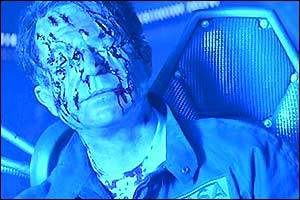
Let's consider Danny Boyle's Sunshine as both a characteristically exaggerated response to environmental crisis and an extended visual pun on the term 'Enlightenment.' The genre is easily the one most in tune with my lizard brain, sci-fi horror, combining an alien menace, cosmic scale, and the latent erotics of the military-industrial complex. The premise is suitably elegant: an elite crew of astronauts have to rejuvenate the dying sun by penetrating it with a huge bomb, thus saving the human race from extinction. There's a jingoism to this film that is no less present for its lack of national identification or corresponding ideological threat. It delivers the jingoism of crisis, its stance resolutely 'post-ideological,' a fantasy wherein the reactionary instincts of the nation-state are subordinated to the non-negotiable reality of impending destruction (though memorialized, aesthetically, by the pretty faces of the globalized cast). Humanity can then be reduced to its more cinema-friendly, individual-universal 'weaknesses,' such as lust for power, envy, moral feeling, and susceptibility to the sublime. All of which prove themselves to be liabilities in the crisis situation, if forgivable as sources of dramatic suspense, bathos, etc. A more 'objective,' classier...right, the UK, post-9/11 version of Armageddon.

So do we then say Sunshine belongs with the recent spate of non-U.S. westerns, the parent genre to a certain dominant mode of science fiction? Naught Thought thinks so, in this piece understanding the already post-national history of the European Enlightenment as one with the history of colonial expansion and imperial violence. The obvious touchstone in contemporary philosophy is with Jean-FrançoisLyotard's essay "Can Thought go on without a Body?" where the extinction of the human body is equated with the death of the sun, the absolute limit of thought. Bodiless thought is not without material conditions, but is also not reducible to preserved remains or combinatoric repetitions, the recorded memories which might manifest in, say, a satellite that outlasts the collapse of the solar system. Artificial intelligence, Lyotard claims, cannot be reducible to a program. It must be able to transgress its own limits, must carry some immanent differend, a complex, a libidinal motor for drives, desires, will. It must suffer. Thought, like the marauding cowboy, must have spurs.

Lyotard's philosophical myth can be read as a gnomic restatement of the question of 'late capitalism' -- how does expansion continue in a post-ontological (post-national) universe? More or less rhetorical, its function is to reinforce the truth of its presuppositions. Post-American westerns and western-infused sci-fi serve as good popular counterparts: anti-heroes slay evildoers in spectacular fashion despite existential ennui. But the intrusion of horror complicates things somewhat. The inversion of the western, horror consists of variations on home invasion rather than the quest. Its villains tend toward the abstract. Like obvious influences 2001, Solaris, and Alien, Sunshine's setting is a 'haunted house in space,' a seemingly familiar structure infected by its vast, unfamiliar outside.

Though the sun's five billion years premature decrepitude is never explained within the film, on the DVD commentary we're informed that an invisible force of matter gets trapped by the mass of the sun and begins to eat its way out. We're also told that because of our sun's relatively middling mass, this could never actually happen. Despite the realism of the hardware and the performances, then, the film is really closer to a thought experiment with set parameters, one of those 'push the fatty or pull the lever' things, than to traditional 'speculative fiction.' And unlike conventional horror there is little mystery even for the characters -- the premise is, not exactly established, but asserted beforehand: "If the sun dies, so do we." Lyotard's question is answered with a simple "no."

Aesthetically Sunshine is wonderful when the sun is front and center -- CGI actually works in space -- and enjoyable in that modern, overbearing way when its not. Though like many movies these days it demands you think it intelligent for quoting the 1970s, and in the end a third-act slide into Event Horizon territory ruins all hope for respectability. After a series of moral dilemmas where the crew makes increasingly irrational blunders deviating from 'the mission' (trying to save the crew of the previous vessel is the first fateful misstep), they find themselves stalked by a crazy speechifying Romantic villain, in the Kurtz/Pinhead vein:

I am Pinbacker, Commander of the Icarus One. We have abandoned our mission. Our star is dying. All our science. All our hopes, our... our dreams, are foolish! In the face of this, we are dust, nothing more. Unto this dust, we return. When he chooses for us to die, it is not our place to challenge God.


Pinbacker's God-given task is to 'enjoy,' once and for all, the limit that the crew is determined to transgress. This limit, the border between the human world tamed by Enlightenment reason and its conditional beyond, is transcendentalized, the products of the former -- organized life, technoscience, the 'modern world' -- understood as a gnostic veneer over the Truth. After all, death, the horizon of experience, makes life itself intrinsically unknowable regardless of what form it takes. "Resembles Life what once was held of Light, / Too ample in itself for human sight?" But the significance of the 'beyond's' effect on the 'here' is reversible: plenitude or negation of meaning. In Lyotard's understanding, if thought dies with the sun, then "everything is dead already." Pinbacker, on the other hand, aims to preserve the dialectic of human and inhuman knowledge by halting its progress, thus sacrificing the human species in exchange for an eternal moment of personal transcendence.

Pinbacker's wish for 'totalitarian' transcendence is countered by the moments of selfless, hopeful transcendence experienced by (some members of) the heroic crew. A moral lesson: being obliterated by the sun while saving people is just as awesome as being obliterated by the sun while exterminating them. Quite apart from the romance of Enlightenment, the film's obscure object of desire, is the persistence of a certain ethical code, staged here as logical responses to objective facts. If the crew had stuck to the mission parameters (if they hadn't been swayed by moral sentiment to try and save the previous crew) they would have all survived. We are reminded over and over again that 'transcendence,' a category which seems to encompass more and more each day, is theft, from man and reason. A delusion, a drug trip, a private spectacle. A luxury. The last shot is the homestead on Earth, saved by what they will never know. In a time of certain crisis, an elect is permitted to live like heroes so that we don't have to. For us the sensible thing is to follow orders. 'They' will never know, but we will, all for the price of a ticket. Certain crisis. Would extinction matter if there were no one there to enjoy it?

Thursday, May 29, 2008

monkeypocalypse

While we were sleeping writing our papers, monkeys executed the first stage of their three-pronged plan to take over the world: learn to control robotic arms with their thoughts.

I don't need to tell you about stage two.


Thanks to Alex Greenberg for the shout-out.

Friday, May 16, 2008

Polygraph 22: Call for Papers

Polygraph 22—Call for Papers
http://www.duke.edu/web/polygraph/cfp22.html

Special Issue: Ecology and Ideology

The contemporary moment abounds with speculation concerning our ecological future. Specialists in a variety of fields forecast immanent catastrophe, stemming from a combination of climate change, fossil-fuel depletion, and consumer waste. The recent bestowal of the Nobel Peace Prize on a group of scientists studying climate change indicates the degree to which "peace" has come to signify ecological balance; even the declaration by the Vatican of a new set of "7 Deadly Sins for the modern age" includes pollution in an attempt to grapple with the potential of individuals to inflict ecological damage on a global scale.

In the name of an impending crisis felt to be collectively shared, new political, cultural, and intellectual alignments are being forged, just as seismic shifts in the flow of global capital once again threaten to "redistribute" the world's resources and people. Ecological crisis has become a 24/7 media event, canvassing the planet in the imagery and rhetoric of disaster. From the halls of research and policy to activist documentary and apocalyptic fantasy, at the news desk, podium, pulpit, classroom, and computer monitor alike, all channels are united by a single underlying conviction: the present ecological catastrophe has humanity as its cause.

Precisely because the answer seems so obvious, we want to know: why now? Where are the points of antagonism in the midst of such apparent consensus, and what is at stake in their difference?

The Polygraph Editorial Collective invites papers concerning any aspect of ecology's relationship to ideology, both interrogating ecology as a location for critique of global capitalism and analyzing the ways in which ecology functions as an ideology in its own right.

Potential areas of interest include:

Political Ecology
Globalization and ecology
Marxism and ecology
"Environmental accounting" as a challenge to the free market
Ecology and capital / consumerism
Ecology as growth market

Eco-Disaster
Peak oil and climate change
Biofuels and the food crisis
Overpopulation and Neo-Malthusianism
Ecology as a rhetoric of control
Figurations of eco-disaster in popular culture

Religion and Ecology
Green apocalypticism and green evangelism
Ecology and world religion

Ecology and gender
Recent articulations of eco-feminism
Eco- & transnational feminisms
Women's work and the global chain of production
Agricultural work and reproduction

Ecologies against ecologies
"Light" vs. "dark green" environmentalism (i.e. deep ecology)
Primitivism and technofuturism
The status of international Green movements

Polygraph welcomes work from a variety of different disciplines, including critical geography, cultural anthropology, political economy, political theology, science studies, and systems theory. We also encourage the submission of a variety of formats and genres: i.e. field reports, surveys, interviews, photography, essays, etc.

SUBMISSION DEADLINE
December 31, 2008

ISSUE EDITORS
Gerry Canavan
Lisa Klarr
Ryan Vu

CONTACT
polygraph22cfp@gmail.com

Thursday, March 20, 2008

kidding on the square

Apologies for the slow posting—we culturemonkeys are just coming off our Spring Break. And preemptive apologies for the post that follows, as well, another public exercise in trying something on for size...

The chart at right is Jameson's Greimas square for Olaf Stapledon's Star Maker, not only one of the finest science fiction novels ever written but a kind of overarching theory of SF, a compendium of all that is possible along a certain trajectory of recombinative imagination. In the case of Star Maker, as the square suggests, that trajectory is the dialectic of the one and the many, the interplay that informs all of the planetary social systems that the novel's narrator visits. The other diagonal represents the theoretical countermovement in the novel, dualism and nondualism, those places where the opposition between the individual and the community is represented as nondialectical (and usually reformulated as good/evil, progress/anti-progress, life/death, futurity/apocalypse, and so on).

Mapping out the novel in this way we find its principal moments and various figurations nicely laid out.

While discussing Star Maker the Futurity group found ourselves playing with a Greimas square of our own, a collaborative square I put forth now not because I believe it is right and complete but because I want to discuss the ways in which it might be wrong.

I've modified the square slightly since we talked about it, which is something we can talk about in the comments.

The square is an attempt to lay out the component subgenres of speculative fiction along these semiotic lines.

We take as our first opposition the difference between science fiction and fantasy/eros, following Jameson's borrowing of Coleridge's distinction between imagination and fancy but aligning "imagination" as much with "the erotic" as with fantasy. Science fiction's theoretical extreme would in this sense be more a novel that is more Star Maker-esque than even Star Maker itself: this is the programmatic business of speculative engineering and genre combinatorics. This is nerdonomics, operating on a scientific-mathematic logic. The erotic, on the other hand, is pure arousal—affect. The relevant aesthetic example here is not the pornographic so much as poetry and myth: the idea of Camelot, outside any consideration of how many people should live inside or how tall the walls the should be. This is the dream logic of pure imaginative play.

On the other axis, we map horror against spectacle, spectacle in the Debordian sense of a manifestation of pure positivity:

The spectacle manifests itself as an enormous positivity, out of reach and beyond dispute. All it says is: “Everything that appears is good; whatever is good will appear.” The attitude that it demands in principle is the same passive acceptance that it has already secured by means of its seeming incontrovertibility, and indeed by its monopolization of the realm of appearances. (The Society of the Spectacle 15)
Horror, then, is anti-spectacle—it promises us violence, real, raw, and uncontrolled. But as with science fiction and the erotic I mean to keep these two terms free from other valences or connotations outside the foundational distinction between positivity and negativity, for as we all know there can be an Dionysian ecstasy to violence just as surely as there can surely be a terrible unfreedom in spectacle. What I'm interested in right now is just the question of imaginative method, trying to identify the sorts of moves that can be made through speculative fiction.

When science fiction combines with horror, we get Frankenstein and its many children; when it combines with spectacle, we get Star Wars. Likewise, when Eros and fantasy combine, we have the seductive myth of the vampire; when it's spectacle and fantasy, we have the pornographic, or, more accurately, the polymorphous perverse.

Borrowing from the apocalyptic suprahistorical cycle of Star Maker, our group then flirted with an ambitious addition to the chart: an attempt to overlap a mapping of the Utopic and the apocalyptic in relation to these terms. We struck upon the notion that perhaps Utopia can be seen as the standpoint of eternity, the position which all the deviations and excesses of the four subgenres—each one trending in its own way towards the boundary condition of apocalypse—are read against...

Friday, March 7, 2008

Time Travel: The Creation of A Temporal Ecology


One tends to mark the birth of time travel as a narratological device with the 1895 publication of Wells’ The Time Machine. Along with a couple of earlier stories: "The Clock That Went Backwards" (1881), "El Anacronopete" (1887: the first to introduce a time machine), Wells' "The Chronic Argonauts" (1888), and Twain's "A Connecticut Yankee..." (1889), these tales form a cluster of literary experiments that one struggles to locate in earlier cultural fictions. The desire to travel back in time seems to be a uniquely cultural-historical formation. The question then arises as to what, exactly, prompts this particular form to emerge as does in the late 19th-C. To do Wells service, he was attending lectures in contemporary physics at the key transformational period between the Newtonian and Quantum eras when scientists began to posit the existence of a fourth-dimension of space which they identified as time. Questions about the possible multi-dimensionality of reality had been previously explored in E.A. Abott’s 1884 novella Flatland, but Wells seems to be the first to illustrate what it could mean for one of those dimensions to be time.

Making time a dimension of space—spatializing time—allows Wells' characters to visit the future as a place. While this is an amazing imaginative tool in itself, providing authors of SF for generations to come with a means by which to manipulate the otherwise linear progression of the traditional fabula, time travel also gestures toward collective experiences of temporality at the turn of the century. Wells' fictional text--again inspired by a particular scientific discourse--illustrates a disjointed relationship to time where the future can be experienced only by overcoming the physical gap between present and future states. This occurs through the transplantation of characters from the fictive present, which might nevertheless be written in past tense, to the distant future.


Wells' innovation similarly opens up the past as a potential site of discovery. Although in The Time Machine ,The Time Traveller can only return to three hours before his initial departure (a theoretical limit often outlined in scientific treatments of this subject), Wells' spatialization of time nevertheless makes the past physically accessible to potential travelers. While 18th-century authors, by contrast, might have had their characters “travel” to the past through an encounter with that culture's inherited archive (thinking of Foucault), later writers achieve an "actual" (in the space of the text) transposition in time. Thus the limits of representation vis-a-vis the past seem to parallel similar limitations in the very experience of history itself where a decided discontinuity exists between the subject (collective or otherwise) of history and the past it seeks to experience; not to mention the Heraclitean/Parmenidean divide over whether or not the past actually continues to exist.


Time travel, appearing as it does in the age of industrialism, might then function as a means to break out of a very particular temporal episteme inaugurated by industrial time and its ruthless march forward, very much in the spirit of Benjamin’s Angel of History. The latent desire of time travel might be to re-create a kind of temporal ecology lost in the industrial era, an ecology unearthed from the repressed cyclicality of “natural” temporal rhythms. In this iteration, time travel is an artificial means of undoing an imposition of mechanized time through, of course, the invention of a fabulous machine.

This might account for the apparently gendered nature of particular types of time travel. In the presentation of time-loop paradoxes, for example in the Terminator films and Heinlein’s “All You Zombies,” returning to the past allows the male protagonist to auto-engender himself either by orchestrating his conception or by actually impregnating his past self. The use of the time-loop paradox as an act of male auto-genesis which, in some cases, bypasses the womb entirely, seems to point to a particularly gendered tension arising out of these longings for temporal manipulation. This type of time travel also seems to artificially re-create a temporal ecology for the traveler, who experiences his life cyclically by affecting causality at either end of the loop.


Women writers who have evoked the time travel trope tend to treat the experience rather differently. In Octavia Butler’s Kindred, the protagonist travels back to antebellum Maryland when a family member from her past “summons” her. Her actual travel occurs in the form of dream (she becomes dizzy and passes out), which suggests that there is already a continuity with the past that does not require mechanistic intervention to motivate. Marge Piercy’s Woman on the Edge of Time similarly utilizes the space of dream as a means by which to travel. While this, in some ways, links these writers up to Proust and Bergson who did not subordinate time to space, it also gestures again toward the question of desire. To interject an eco-feminist perspective, women, despite the pressures of industrial temporality, have remained connected to cyclical experiences of time through both menstruation and gestation, both of which defy (often embarrassingly) the “stop-motion” Taylorism of early and late industry. This link, however, might account for the formal differentation of time travel between male and female writers of SF, with male writers seeking to rediscover a lost experience of time.

Saturday, February 23, 2008

Dystopia as Economic Indicator

We charted the number of dystopian movies in the U.S. for each of the last 30 years, against economic downturns, and found that dystopian movies are counter-cyclical. That is, dystopian films do best when the economy is booming, and a fall in the number of dystopian movies may predict a recession.

(Click for a full-sized version of the chart)

Friday, February 22, 2008

History and The Forever War (1974)

The Forever War (1974), a work of science fiction written more than three decades ago? I'm aware this question carries with controversial assumptions--Must we have an orientation? Can we?--but I do think a questioning of initial orientation is useful, particularly when we write about it in public.

One approach I have mixed feelings about brackets the form and content and takes fictional works of the past as evidence of a particular sentiment, in the case of Haldeman, it would be opposition to the Vietnam War (which ended, of course, a year later in 1975). I suppose one might conceive of analogous approaches to other works of literature--Orwell's 1984 or even Terminator or Terminator 2 (evidence of some fear about technology). In short, the narrative is taken as historical data, providing concrete evidence of some opinion or pointing in the direction of Zeitgeist.

Outside the academic context I'm familiar with, I think this approach/orientation is pretty widespread. "Oh, the novel is responding to X," would be the refrain. I'm not even quite sure how to name it. Is it naive cultural historicism? (Actually, I'm sure that "Oh, the novel is responding to X" could encompass countless interpretive orientations.)

But let's continue with this provisional approach. There are countless problems with it, most notably that it brackets all considerations of form and most consideration of any content that conflicts with the interpretation. Yet I don't think the reductionism is necessarily bad. For one, being able to speak about novels and film in this way connects us up at least preliminarily with larger projects of social and cultural history.

So I'm attracted to the idea of beginning with this, shall I say "popular" approach, and, identifying some of its aporia and contradictions, proceed in an iterative, dialectical manner.

So let's begin. What are the developments (political, social, technological, etc...) that this book provides evidence of? (I suppose I should say I'm not entirely clear on what kind of evidence I'm talking about. I suppose at a minimum, it provides evidence of some level of awareness of such developments, such as I (and others writing about Haldeman) recognize them.)

  • Vietnam War (~1959 to 1975)
  • Human Spaceflight to other Planets / Moons: Apollo Moon landing July 20, 1969.
  • Human Spaceflight: USSR: Yuri Gagarin (April 12, 1961).
  • Expanding Knowledge of Solar System: Pluto was only identified in 1930. Titan identified in 1944. Charon, Pluto's moon (not the Charon in the book), was identified in 1978.
  • Relativity: 1905?
  • Search for extraterrestrial intelligence: First SETI conference in 1961.
  • Wormholes: Term coined by physicist John Wheeler in 1957.
  • Relevance of countless cultural events and movements of the 1960s and 1970s.
  • nth wave overpopulation fears? Worldwatch founded in 1974...
  • Psychopharmacology: 1950s on..
  • Computers doing probability calculations (See p. 200): Fourth generation Computers: November 15, 1971, Intel releases the 4004, first commercial microprocessor.
  • Laser weapons: First working laser in May 1960. Introduced to public in 1959. "The LASER, Light Amplification by Stimulated Emission of Radiation"

No doubt we need more additions..

There are so many problems with this approach. I think you can count several peaking out even from my description.

Friday, February 15, 2008

philip k. dick link explosion

I've been blogging for a few years now, and over that time I've linked to Philip K. Dick related material a whole lot of times. Here, in honor of reading Dr. Bloodmoney this week, are just a few PKD highlights, all to the glory of the man Fredric Jameson once called "the Shakespeare of science fiction":

* "How to Build a Universe That Doesn't Fall Apart Two Days Later." In some ways this is the definitive PKD essay, and it's the one referenced somewhat famously at the end of Waking Life.

It was always my hope, in writing novels and stories which asked the question "What is reality?", to someday get an answer. This was the hope of most of my readers, too. Years passed. I wrote over thirty novels and over a hundred stories, and still I could not figure out what was real. One day a girl college student in Canada asked me to define reality for her, for a paper she was writing for her philosophy class. She wanted a one-sentence answer. I thought about it and finally said, "Reality is that which, when you stop believing in it, doesn't go away." That's all I could come up with. That was back in 1972. Since then I haven't been able to define reality any more lucidly.
* Another great essay at Grey Lodge Occult Review: "If You Find This World Bad, You Should See Some of the Others."
We are accustomed to supposing that all change takes place along the linear time axis: from past to present to future. The present is an accrual of the past and is different from it. The future will accrue from the present on and be different yet. That an orthogonal or right-angle time axis could exist, a lateral domain in which change takes place -- processes occuring sideways in reality, so to speak -- this is almost impossible to imagine. How would we perceive such lateral changes? What would we experience? What clues -- if we are trying to test out this bizarre theory -- should we be on the alert for? In other words, how can change take place outside of linear time at all, in any sense, to any degree?
* R. Crumb's comic, "The Religious Experience of Philip K. Dick."

* The first law of kipple is that kipple drives out nonkipple.

* Philip K. Dick and drugs.

* Philip K. Dick on Kurt Vonnegut.
Interviewer: What did you think of Vonnegut’s attitude towards his characters (in Breakfast of Champions)?

PKD: Disgusting and an abomination. I think that that book is an incredible drying up of the liquid sap of life in the veins of a person like a dead tree…that’s what I think. I also love Kurt Vonnegut.
* Philip K. Dick and the Kennedy Assassination. (Warning: spoilers for the last book we're going to read this semester, also a Dick novel, Dr. Futurity.)

* Profiles of Philip K. Dick from The New Yorker, The Washington Post, and the Times. Interviews with Philip K. Dick. Lethem on Philip K. Dick. Again. Stanislaw Lem on PKD.

* Jameson on Dr. Bloodmoney.

Saturday, February 2, 2008

Speculative Realism

J.G. Ballard, intro to French 1973 edition of Crash:


"The kind of imagination that now manifests itself in science fiction is not something new. Homer, Shakespeare, and Milton all invented new worlds to comment on this one. The split of science fiction into a separate and somewhat disreputable genre is a recent development. It is connected with the near disappearance of dramatic and philosophical poetry and the slow shrinking of the traditional novel as it concerns itself more and more exclusively with the nuances of human relationships. Among those areas neglected by the traditional novel are, above all, the dynamics of human societies (the traditional novel tends to depict society as static), and man's place in the universe. However crudely or naively, science fiction at least attempts to place a philosophical and metaphysical frame around the most important events within our lives and consciousness.

...

In the past we have always assumed that the external world around us has represented reality, however confusing or uncertain, and that the inner world of our minds, its dreams, hopes, ambitions, represented the realm of fantasy and the imagination. These roles, too, it seems to me, have been reversed. The most prudent and effective method of dealing with the world around us is to assume that it is a complete fiction -- conversely, the one small node of reality left to us is inside our own heads. Freud's classic distinction between the latent and manifest content of the dream, between the apparent and the real, now needs to be applied to the external world of so-called reality.

...

I feel myself that the writer's role, his authority and license to act, has changed radically. I feel that, in a sense, the writer knows nothing any longer. He has no moral stance. He offers the reader the contents of his own head, he offers a set of options and imaginative alternatives. His role is that of the scientist, whether on safari or in his laboratory, faced with a completely unknown terrain or subject. All he can do is to devise hypotheses and test them against the facts."


William Gibson, 2007 (via Ballardian):

"Well, I thought that writing about the world today as I perceive it would probably be more challenging, in the real sense of science fiction, than continuing just to make things up… If I’m going to write fiction set in an imaginary future now, I’m going to need a yardstick that gives me some accurate sense of how weird things are now. ‘Cause I’m going to have to go beyond that… But I don’t know if I’ll be able to do it again. I don’t know if I’ll be able to make up an imaginary future in the same way. In the ’80s and ’90s, as strange as it may seem to say this, we had such luxury of stability. Things weren’t changing quite so quickly in the ’80s and ’90s. And when things are changing too quickly, as one of the characters in Pattern Recognition says, you don’t have any place to stand from which to imagine a very elaborate future."


Lukacs, attacking Bloch's support for the Expressionist and Surrealist modernist avant-gardes, on "the anticipatory function of ideology" (from "Realism in the Balance," 1938):
"To remain within the sphere of literature, we need only remind ourselves of what Paul Lafargue has to say about Marx's evaluation of Balzac: 'Balzac was not just the chronicler of his own society, he was also the creator of prophetic figures who were still embryonic under Louis Philippe and who only emerged fully grown after his death, under Napoleon III.' But is this Marxian view still valid in the present? Of course it is. Such 'prophetic figures,' however, are to be found exclusively in the works of the important realists.

...

There is nothing mysterious or paradoxical about any of this -- it is the very essence of all authentic realism of any importance. Since such realism must be concerned with the creation of types (this has always been the case, from Don Quixote down to Oblomov and the realists of our own time), the realist must seek out the lasting features in people, in their relations with each other and in the situations in which they have to act; he must focus on those elements which endure over long periods and which constitute the objective human tendencies of society and indeed of mankind as a whole.

Such writers form the authentic ideological avant-garde since they depict the vital, but not immediately obvious forces at work in objective reality. They do so with such profundity and truth that the products of their imagination receive confirmation from subsequent events -- not merely in the simple sense in which a successful photograph mirrors the original, but because they express the wealth and diversity of reality, reflecting forces as yet submerged beneath the surface, which only blossom forth visibly to all at a later stage. Great realism, therefore, does not portray an immediately obvious aspect of reality but one which is permanent and objectively more significant, namely man in the whole range of his relations to the real world, above all those which outlast mere fashion. Over and above that, it captures tendencies of development that only exist incipiently and so have not yet had the opportunity to unfold their entire human and social potential. To discern and give shape to such underground trends is the great historical mission of the true literary avant-garde.

...

So what really matters is not the subjective belief, however sincere, that one belongs to the avant-garde and is eager to march in the forefront of literary developments. Nor is it essential to have been the first to discover some technical innovation, however dazzling. What counts is the social and human content of the avant-garde, the breadth, the profundity and the truth of the ideas that have been 'prophetically' anticipated.

In short, what is at issue here is not whether or not we deny the possibility of anticipatory movements in the superstructure. The vital questions are what was anticipated, in what manner and by whom?"


see also a discussion of (speculative) realism in philosophy here.

Thursday, January 31, 2008

Vonnegut's Player Piano

This post is about Vonnegut's 1952 novel Player Piano. In thinking about the novel, I decided to focus on one of the premises, namely, that ever increasing automation leads to mass unemployment. This might be seen as the easy way out since it's clear today Vonnegut was off in important ways, but I'm interested in the premise as an (explicit) engagement with ideas of the time—more evidence for Jameson's claim that “few other literary forms have so brazenly affirmed themselves as argument and counterargument.”1

Here's a great example from early in the text of Vonnegut's engagement with Norbert Weiner's Cybernetics or, Control and communication in the animal and the machine, published in 1948.

Katherine and Paul are taking. Katherine begins:

“It seemed very fresh to me—I mean that part where you say how the First Industrial Revolution devalued muscle work, then the second one devalued routine mental work. I was fascinated.”

“Nobert Wiener, a mathematician, said all that way back in the nineteen-forties. It's fresh to you because you're too young to know anything but the way things are now.”

“Actually, it is kind of incredible that things were ever any other way, isn't it? It was so ridiculous to have people stuck in one place all day, just using their senses, then a reflex, using their senses, then a reflex, and not really thinking at all.”

...

“To the people who were going to be replaced by machines, maybe. A third one, eh? In a way, I guess the third one's been going on for some time, if you mean thinking machines. That would be the third revolution, I guess—machines that devaluate human thinking. Some of the big computers like EPICAC do that all right, in specialized fields.”2


Of course the third revolution has arrived. The loan officer is one of the best examples of this. Deciding whether or not someone or some business was credit worthy used to be a job requiring significant skill and expertise. Now the vast majority of such decisions can be made faster and more accurately by statistics and information technology. In this case, a computed “credit score” has replaced human thinking to a breathtaking extent.


Of course, as I imagine most people have observed, there's nothing close to mass unemployment in the United States, even as population has doubled since Vonnegut wrote the novel in 1952. I don't have much more to say about the prediction except that I think current Science fiction reflects the consensus pretty well. Machines in Kim Stanley Robinson's Mars trilogy do just about everything, but there's still plenty for humans to do on Mars and on Earth—to say nothing of the very premise of KSR's novel and so many like it: humans, finished expanding on Earth, find things to do outside its gravity well.

Like Vonnegut, I share the concern that the increasing use of “machines,” broadly construed, will lead to stratification in society. Yet, if I compare some European countries with America, I find very similar degrees of mechanization/computerization and very different degrees of income stratification. This inclines me to think that the performance of machines is as determinative as Vonnegut seems to be arguing.

1Fredric Jameson, Archaeologies of the Future (Verso, 2005), 2.

2Kurt Vonnegut, Player Piano (New York: Scribner's, 1952), 13.